
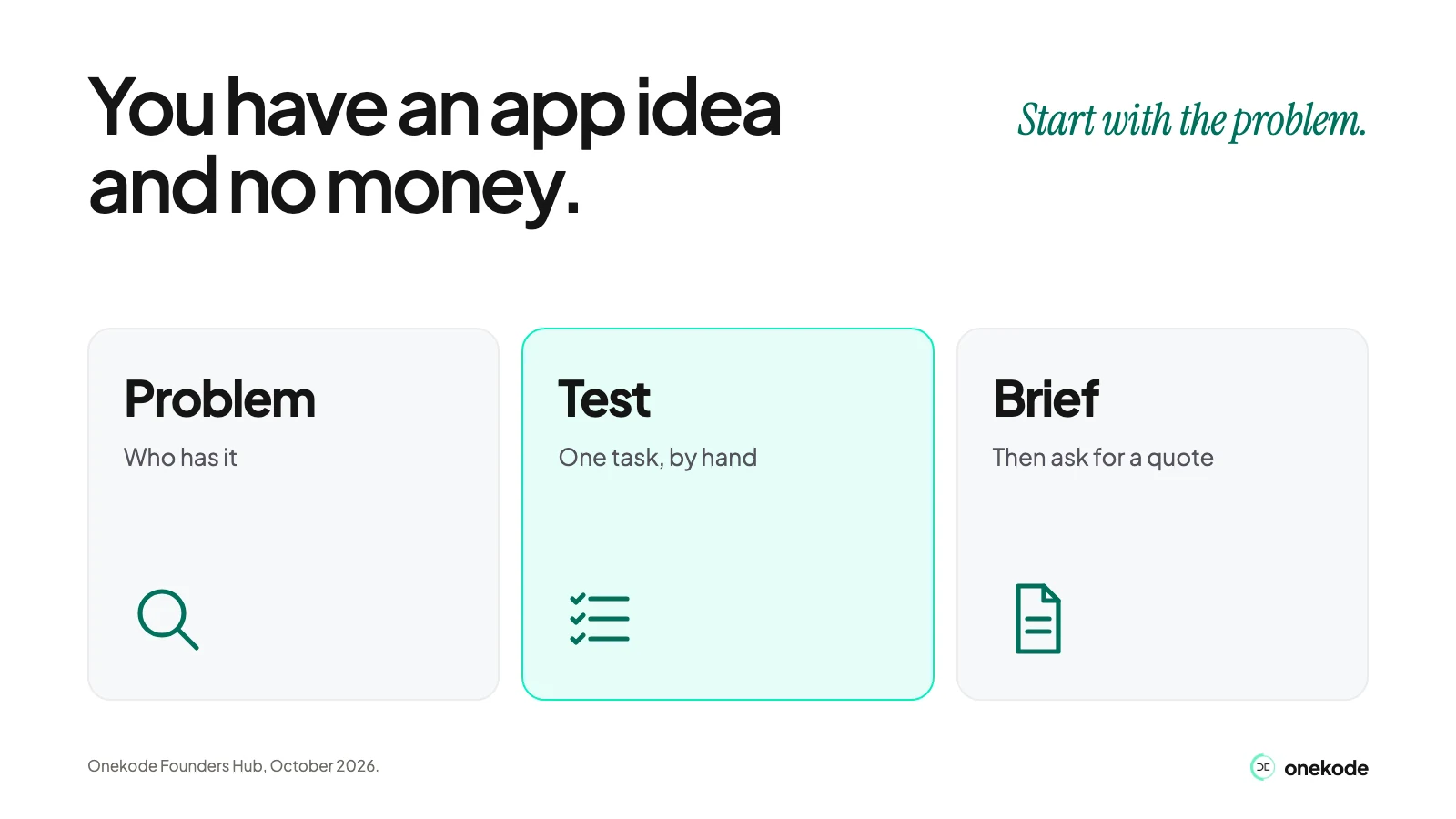
You can start with no money. Write down who has the problem and find one real example of it. Then try the core task by hand before anyone builds anything. That costs time, not a budget. It also gives you what any later conversation needs.
I have a great app idea but no money. What can I do first?
Write down who has the problem and what they do about it at the moment. Then find one real example. All of this is free.
Start with one sentence. Fill in this form:
For [person], help with [task] so they can [outcome].
An example of the form, not a finished idea.
Then mark each part. What have you seen with your own eyes? What are you guessing? A first draft is often mostly guesses. That is fine. It shows you what to find out next.
Find a real instance of the problem before you write a feature list. That could be a person who has it, or a post where someone describes it. The same first step works for any idea, an app or an invention.
You are not alone in this spot. On 13 January 2026, a founder on r/AppIdeas (post) wrote that they had an app idea, no prototype and "no money". On 2 October 2026, a founder on r/learnprogramming (post) called themselves "not a programmer" and wanted to turn the idea into a real business. Each is one founder's account, not research.
For the full test of demand, competition and conversations, read Is your app idea worth building?. To look for real posts about the problem, try Idea Check. It is free, needs no sign-up, and shows real posts with links and what is still unknown. It gives you evidence to look at. It gives no score and no verdict.
Is it money, coding skills or time that is stopping me?
Money, coding skills and time are three different limits. Each has a different next step, and you can have all three.
Many people have an app idea but no programming skills, and assume that stops them. Having no skills is one limit. Having no money is another. Work out which one you really have.
| Limit | What to do next |
|---|---|
| No money to pay anyone | Study the problem and try the smallest task yourself before you hire anyone. |
| No coding skills | Pick a route that fits the task and your time. The routes are in Should I learn to code, use an AI builder or ask for help? |
| Little time | Shrink the first outcome before you pick a route. Aim for one task that one person can finish. |
Do the cheap work first. Whatever your limit, the first steps cost time, not money: writing the problem down, finding a real example, and watching one person try the task. They also make every later choice easier, because you will know what you are choosing for.
On 1 February 2026, a founder on r/startups wrote "I do not have coding experience or the time to learn" (post). That is two limits at once. On 16 August 2026, another founder on r/startups wrote "I’m happy to pay for good work." (post). Having no skills is not the same as having no money. Each is one founder's account, not research.
Can I test the idea without a finished app?
Often yes. Walk one person through the core task on paper, with a simple mock-up, or by doing the task for them by hand.
Three exercises you can do for free:
- A paper walkthrough. Draw the screens on paper. Ask a likely user to show you what they would tap.
- A simple mock-up. Make a few linked screens with a free design tool. Let a likely user click through the core task.
- The task by hand. If the app would match two people, make that match yourself, by message, for one person.
These are options, not a substitute for software in every case.
Pick the one closest to the real task. If the core job is a booking, watch someone try to book. If it is a calculation, do the calculation for them and hand over the answer. Either way, you learn what the app has to do before anyone writes code.
Watch where the person gets stuck, what they already use, and what they do next. Write down what you don't know. Don't give it a score.
A kind reaction does not prove a business. Neither does an answer from an AI tool, or a sign-up on its own. For the fuller test, read Is your app idea worth building?.
Should I learn to code, use an AI builder or ask for help?
It depends on your time, how big the first task is, and whether you can tell if the result works.
On 7 March 2026, a founder on r/AppBusiness (post) asked whether to learn some coding basics first, use no-code tools, or look for a technical cofounder. That is the choice in front of you. It is one founder's account, not research.
| Choice | Fits when | Watch for |
|---|---|---|
| Learn the basics | You have months and enjoy it. | A slow start. |
| Use an AI builder | The first task is small. | Results you can't judge. |
| Find a technical partner | You can't build the app or judge it. | Who owns what. |
| Ask a developer for a quote | You have a brief. | See the next section. |
Routes can be combined. You might learn enough to judge a builder's result, or bring in a partner after a first mock-up. Whatever you pick, write down what the first version must do and what it can leave out. That one page helps with every route, including a later quote.
This is not a ranking. Choosing a tool does not remove the need to check what it made. For the actual sequence, read How to build an app with AI. A guide on how to start building an app is planned.
Worried about someone copying it? Can you sell or protect an app idea? →
What should I have ready before I ask for a quote?
A rough brief is enough. Notes, a feature list or mock-ups all count.
Bring these:
- Who it is for, and the problem.
- The one core flow.
- What already exists.
- What can wait.
- Your launch goal.
You do not need a formal specification. Keep each item to a line or two. For the core flow, write the steps a user takes, from opening the app to getting what they came for. For what can wait, list the features you like but the first version does not need.
Ask each bidder what to remove from the first version, and compare quotes for the same scope. A quote only means something if every bidder prices the same thing, so send everyone the same brief. For the cost framework, read What an App Costs.
Our Price and Scope Check works from that brief. It looks at scope, a cost range, time, and three questions to ask anyone who bids. It stops short of a fixed quote or a plan. It is not a test of demand, and it is not a free build.
What if I still cannot pay to build it?
Stopping here is fine. Keep what you have: the one-page problem, what you saw, and what you still don't know.
A plan, early evidence and a prototype are three different things. A plan says what you would do. Early evidence shows that real people have the problem. A prototype is something a person can try. Work out which one you hold, and say so plainly when you talk to anyone else.
Nothing here expires. A written problem, a few real examples and a list of unknowns are still worth having later. They are the first things any developer, partner or funder will ask for.
An idea alone does not entitle anyone to free work or investment. If you have evidence that people have the problem, a conversation about funding or a partner gets easier. Without it, it rarely does.
If you now have a brief, the Price and Scope Check below is the next step. If you don't, keep the groundwork and come back when you do.
Have a brief, even rough notes? Send it for a free Price and Scope Check.
Only what you are happy to share. You can stop after it.