
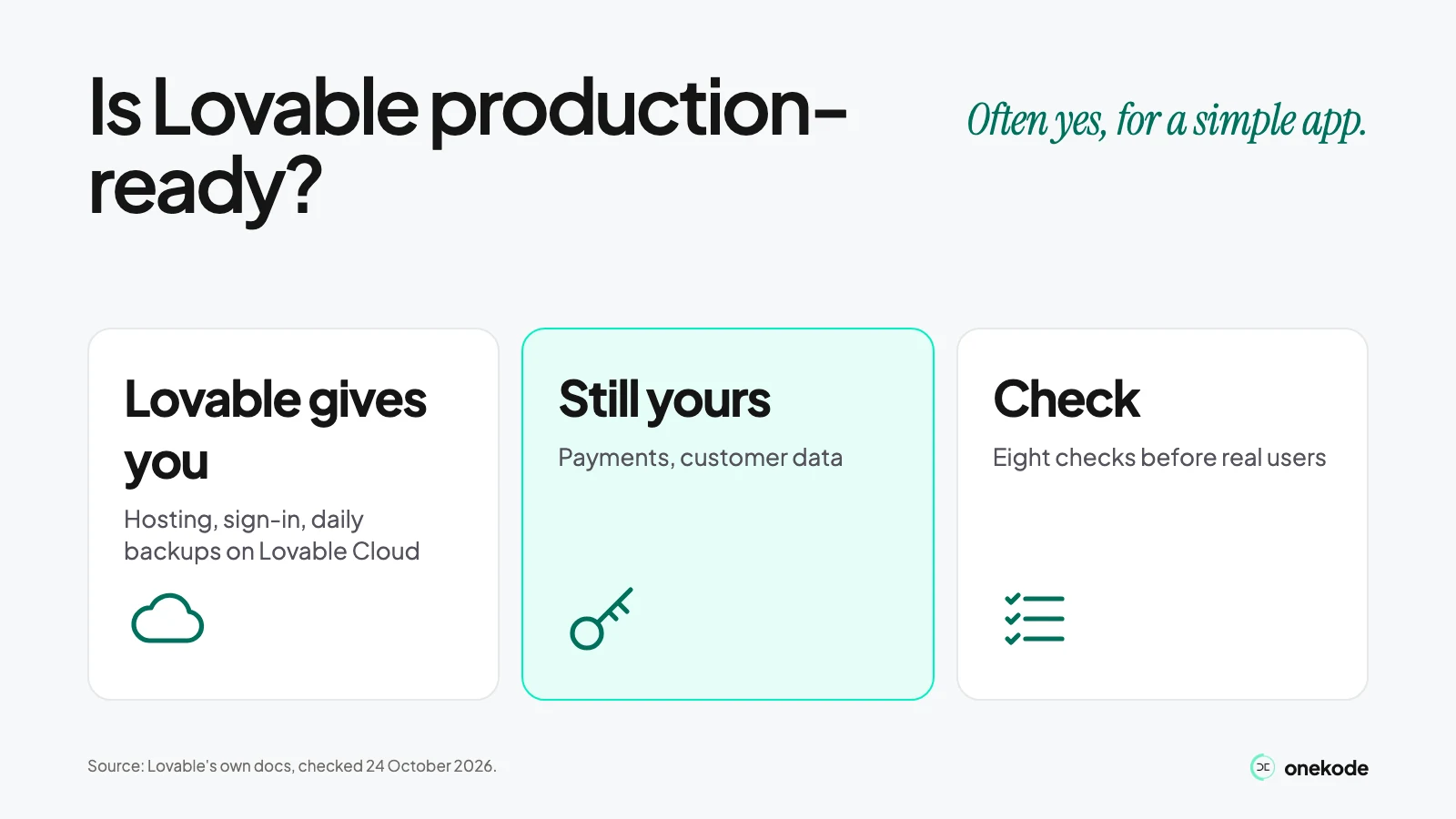
Lovable's docs checked 24 October 2026.
Often yes, for a simple app. Lovable hosts it, puts it on your own domain on a paid plan, and on Lovable Cloud backs up your database every day. With logins, payments or customer data, the rest is still yours: Lovable's docs say you are responsible for your app's security needs (Lovable docs, checked 24 October 2026). This page shows what Lovable gives you, what is left, and eight checks to run before real users arrive.
Can you take a Lovable app to production?
Yes. Lovable says it "takes your idea all the way to production", and it hosts your app. Whether your app is ready depends on what it does.
That is Lovable's own claim, on its Lovable for Work page (checked 24 October 2026). The page does not use the phrase "production-ready". It says hosting, logins and roles come as standard.
A simple app is one job. It has no logins, no payments and no customer data. An app with any of them is another job, and Lovable's docs say part of that job is yours. The next sections show which part.
Our guide to Prototype, MVP or Ready to launch gives three rungs, in these words:
- Prototype shows the idea. Screens and flows with sample data. A builder does this well, often in days.
- MVP gets real people using it. Login, real data, one core workflow, basic security. A builder often gets you there, if you check the database rules.
- Ready to launch holds real users after launch. Testing, admin tools, monitoring and the app store releases. With payments, several kinds of user or sensitive data, this usually takes a developer.
One founder on r/lovable (20 Feb 2026) asked whether Lovable suits a complete app, with logins, a database and payments, or only first versions and prototypes. One person's account, not research.
What does Lovable give you for real users?
Publishing, hosting with SSL, a built-in backend, automatic scaling and a scan at publish, all in Lovable's own words.
- Publishing. It deploys a snapshot to a URL you can share. Later changes go live only when you click "Publish changes". Publishing is free, even at zero credits (Publish, checked 24 October 2026).
- Hosting. Lovable lists "Production hosting with custom domains, automatic SSL, and global delivery". A custom domain is on paid plans (Deployment, hosting and ownership; Publish, checked 24 October 2026).
- Lovable Cloud. A built-in backend with a database, storage, authentication, realtime and functions, built on Supabase's open-source foundation (Lovable Cloud, checked 24 October 2026).
- Scaling. In Lovable's words, "App hosting scales with traffic automatically". You adjust the database's instance size as the app grows (Lovable Cloud, checked 24 October 2026). We make no load claim of our own.
- A Quick scan at publish. It checks database access rules, npm dependencies and MCP exposure. Findings do not block publishing by default (Security; Publish, checked 24 October 2026).
- Drafts. You try changes in a copy of your project (Drafts, checked 24 October 2026).
One more line from Lovable Cloud: "Lovable uses one credit balance" for building your app, hosting it and running the backend (checked 24 October 2026).
What does Lovable leave to you?
Security, for one. Lovable's docs say its tools "cannot guarantee complete security" and that you are responsible for your app.
The words are from Lovable's Security page (checked 24 October 2026). The rest, each in Lovable's own words:
- "You are responsible for ensuring that your app meets the security requirements" that suit its use (Security, checked 24 October 2026).
- For sensitive data or critical functions, Lovable suggests "an additional professional security review" (Security, checked 24 October 2026).
- Scan findings "do not block publishing by default", but "you should resolve critical issues before making your app available" (Publish, checked 24 October 2026).
- The gaps its docs describe. On Lovable Cloud there is one database, and you restore to a daily backup, not to a moment between (next two sections). Lovable does not move a project from the built-in backend to your own Supabase in one step (section 6).
For the scan detail, see Is your AI-built app safe?
One founder on r/nocode (27 Aug 2026) built a small app in Lovable. The screens were done, but they were nervous about "the stuff I cant see": users seeing each other's data, admin permissions, exposed keys. One person's account, not research.
Does Lovable have a test version separate from the live app?
Not on Lovable Cloud, since 5 October 2026. Drafts use your real data.
On Lovable Cloud, Lovable retired its Test and Live beta and replaced it with drafts. Drafts let you try changes in a copy of your project, but "a draft uses your project's real data", so what you add or change while testing is real. On Lovable Cloud, sign-in methods, secrets, backend functions, payments and email settings are changed in the main version and can affect your published app. Accepting a draft does not publish it (Lovable environments and Drafts pages, checked 24 October 2026).
Some founders do one of these instead: add test records you can recognise and delete, plan big changes, or keep a copy project on its own backend.
If a change goes wrong, see When your AI builder keeps breaking.
This is about Lovable Cloud. We make no claim about projects on your own Supabase.
One founder in a Lovable group on Facebook (8 Aug 2026) wanted future builds to have "a development version and a live prod version". One person's account, not research.
Does Lovable back up your database?
On Lovable Cloud, yes: one backup a day, kept for about 14 days. Keep your own export outside Lovable too.
Export the database and keep the file outside Lovable. To see your data yourself, download a table as CSV. Download storage files separately.
The export covers the database only, not storage files. It runs only while the database is running, so a project paused for credits has to be resumed before it can export. Lovable states the limits: up to 15 GB of storage, an export file of at most 5 GB, and one export every 24 hours.
You restore to a daily backup, not to a moment between. A restore cannot be undone and loses anything created after the backup, so it is not a test to run on a live app.
On your own Supabase, backups are set up and paid for in Supabase.
All of this is from Lovable's Database backups and Supabase integration pages (checked 24 October 2026).
One founder in a Lovable group on Facebook (3 Mar 2026) asked how the databases in Lovable Cloud are backed up, and how often. One person's account, not research.
Should you stay on Lovable Cloud or use your own Supabase?
Both work. They differ in who runs the backend. We recommend neither.
Lovable Cloud is managed and paid in credits. The region cannot be changed once it is enabled. Your own Supabase gives "direct ownership of the backend": your own account and billing, and full access to the Supabase dashboard. Backups, instance size and pausing are managed by you (Lovable Supabase integration and Lovable Cloud pages, checked 24 October 2026).
Before going live on your own Supabase, every table needs Row Level Security policies. See Is your AI-built app safe?
There is no one-click move either way. Lovable "does not move a project from the built-in backend to your own Supabase project in one step". Moving from Supabase to the built-in backend "is not supported" (Lovable Cloud, checked 24 October 2026). For the move itself, see Export your code.
One founder on r/lovable (20 Jul 2026) with a live app asked what happens when a project needs "a proper development and deployment workflow". One person's account, not research.
What does production-ready mean, in plain checks?
Eight checks. Lovable gives you part of some and none of others.
A production ready MVP, a production ready prototype, a Lovable production readiness checklist: they all come down to the same checks. Going from prototype to production means holding real users, real data and real changes. Each check below says what Lovable's docs give you and what is still yours.
| # | Check | What Lovable gives you (its docs, checked 24 October 2026) | What is still yours | You / Not yet |
|---|---|---|---|---|
| 1 | You own it | Your code is yours. Git sync keeps it in your own repository. The app can be hosted anywhere | The repository, the domain and the backend accounts in your name. Know what happens if you stop paying | ☐ You ☐ Not yet |
| 2 | Each user sees only their own data | A Quick scan at publish that checks database access rules. Lovable's Supabase page reminds you to set Row Level Security policies on every table | Test it as two different users. Lovable says security is your responsibility. See Is your AI-built app safe? | ☐ You ☐ Not yet |
| 3 | You can get the data back | On Lovable Cloud: a daily backup, kept about 14 days, and an export | Export the database and keep the file outside Lovable. To see your data yourself, download a table as CSV. Download storage files separately. A project paused for credits has to be resumed before it can export. A restore goes back to a daily backup, cannot be undone and loses anything newer. On your own Supabase, backups are yours to set up | ☐ You ☐ Not yet |
| 4 | Money and login work end to end | Built-in sign-in on Lovable Cloud. Payments settings live in the main version | A real card, a receipt and a refund. Sign-up, password reset and each role. The new-user flow after every deploy. If a payment goes through but nothing unlocks, see Payments in your app. For the fix-first order, see Keep, fix or rebuild your app | ☐ You ☐ Not yet |
| 5 | You can change the live app safely | Drafts, then "Publish changes". On Lovable Cloud, no separate test database since 5 October 2026 | Test records you create yourself. A plan for big changes. A way back: see When your AI builder keeps breaking | ☐ You ☐ Not yet |
| 6 | You can see what breaks | Nothing on this page | Know where errors show up and who looks at them | ☐ You ☐ Not yet |
| 7 | Someone other than the tool has looked | A scan that, in Lovable's words, "cannot guarantee complete security" (Security page). For sensitive data, Lovable suggests "an additional professional security review" | Run Build Check on the code. Have a person look at money and customer data | ☐ You ☐ Not yet |
| 8 | Real people have used it | Nothing | Three people who are not you try it from the sign-up screen. The Launch List has the full steps | ☐ You ☐ Not yet |
Caption: From Lovable's own docs, checked 24 October 2026, and our reading. Docs change, so check the page before you rely on a line.
The full list is the Launch List →
Paste your GitHub link into Build Check for a plain-English read of what the code shows. Lovable code is TypeScript and React, which Build Check reads.
What do founders report after taking a Lovable app live?
Both things happen. Single accounts, in both directions. Each is one person's account, not research.
Ask on Reddit whether Lovable is production ready and you hear both.
A founder on r/lovable (23 Dec 2025) had 30 paying users and an app that "hasn't broken once". They still worried, because they had never written code themselves.
Another on r/lovable (2 Feb 2026) deployed right after a viral video. Sign-up broke for new users for three days. Their lesson: test a fresh sign-up, first login and first action after every deploy.
Others ask for a test version, backups and a proper workflow, as the sections above show.
If a payment goes through and nothing unlocks, see Payments in your app →
When do you need a developer?
For money, login and customer data, yes, someone should look. You can do the rest yourself.
You can do checks 1, 3, 5, 6 and 8 yourself. Checks 2 and 4 touch money and customer data, and check 7 needs a person.
Deciding whether to keep, fix or rebuild? Read Keep, fix or rebuild your app. Ready to hire someone to finish it? Read Hire someone to finish your app. If the app breaks every time you prompt, read When your AI builder keeps breaking.
What should I do next?
Send the link. We show you what stays, what needs fixing and what blocks launch.
The Free Build Audit is free and limited each week. It does not say your app is ready, and we do not promise it. If you want us to do the work, the paid route is Finish and Launch.